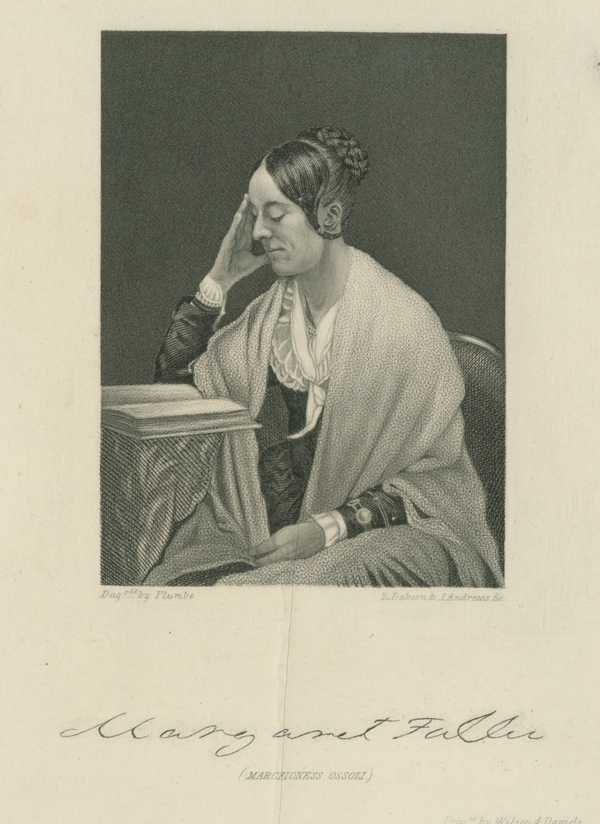
S. Margaret Fuller. Woman in the Nineteenth Century (1855), frontispiece.
S. MARGARET FULLER (1810 – 1850)
After reading her way through her father's library as a child in Massachusetts, Margaret Fuller studied classical and European languages as well as philosophy in Cambridge. There she quickly became the precocious youngest member of Boston's intelligentsia, befriending philosopher Ralph Waldo Emerson, journalist Harriet Martineau, and educator Bronson Alcott, who offered her a teaching position at the progressive Temple School. A talented instructor, she taught for only a few years before moving with her mother and siblings to a house in a Boston suburb.
Once Margaret Fuller joined their ranks, the formerly loose-knit group of free-thinking Bostonians formed the Transcendentalist movement. Unlike the proponents of a doctrinal philosophy or religion, Transcendentalists advocated "a free life of the free spirit" and sought to achieve understanding and personal growth through their frequent "Conversations," in which Margaret Fuller, an energetic, insightful speaker, played a key role. She hosted several series of single-sex Conversations to offer the women of her circle an opportunity to discuss such topics as education, religion, women's rights, health, and art. Charging a fee for attendance, she was thus able to support her family while pursuing the exchange of ideas and the friendships that she considered her truest vocation.
In 1840 she published, with Emerson and others, the first issue of the Transcendentalist magazine the Dial, and she contributed artistic and social criticism regularly to both her own paper and to Horace Greeley's New-York Daily Tribune. She also produced a travel diary and a feminist tract, Woman in the Nineteenth Century, before traveling to Europe in 1845, where the political instability of the continent and the potential for republican revolution excited her. In Italy she met and fell in love with a young nobleman named Angelo d'Ossoli, and she joined him as a freedom fighter in the 1849 rebellion. After the struggle for Italian republicanism failed, they set sail with their child for the United States, and, just a few hours from the New York harbor, a storm destroyed the ship. The body of her child washed up on the shore, but Margaret Fuller was never seen again.
In 1846, Edgar Allan Poe described her in his “The Literati of New York City. No. IV,” in Godey’s Lady’s Book, v. 33, p. 74-75:
She is of the medium height; nothing remarkable about the figure; a profusion of lustrous light hair; eyes a bluish gray, full of fire; capacious forehead; the mouth when in repose indicates profound sensibility, capacity for affection, for love— when moved by a slight smile, it becomes even beautiful in the intensity of this expression; but the upper lip, as if impelled by the action of involuntary muscles, habitually uplifts itself, conveying the impression of a sneer.
Other portraits appear in:
John S. Hart, ed. Female Prose Writers of America (1852), plate opposite p. 237.
Sarah J. Hale, ed. Woman’s Record (1853), p. 665; also 1855 ed.
Mrs. Newton Crosland. Memorable Women (Boston, 1854), plate preceding p. 321.
Evert A. and George L. Duyckinck, eds. Cyclopaedia of American Literature (1855), vol. 2, p. 526.
Abner D. Jones. The American Portrait Gallery (New York, 1855), p. [675].
Abner D. Jones, ed. The Illustrated American Biography, vol. 3 (1855), p. 487.
The Home: A Fireside Monthly Companion and Guide, vol. 2 (1856), p. 5