
The Stewardship Program


Become a Steward of the collections of the Library Company of Philadelphia! Through our new Stewardship Program, you can support the purchase of interesting and important rare books, pamphlets, prints, and photographs. By sponsoring items selected for purchase by our curators, you can help us strengthen and deepen our collections. We will periodically add to this list new items available for stewardship, and we will report when items previously listed have been sponsored, and by whom. Your gift will also be acknowledged in our Annual Report and noted in our permanent accession record. And we will also record your name on a special bookplate affixed to or kept with the item. Please review the stewardship opportunities below, and watch for additions to this list in future editions of our E-News!


Subscribe to the LCP E-News Brief
Please enter your email here:


[Bound pamphlet volume, primarily Rhode Island imprints, 1785-1821]


[Bound pamphlet volume, primarily Rhode Island imprints, 1785-1821]

The funeral sermon shown here is bound in a pamphlet volume with eight other quite rare, mostly Rhode Island sermons.  Most of the sermons in the volume were preached on occasion of particularly untimely deaths, including, in one instance, the controversial execution of the thief and general ne’er-do-well John Dixson.  Several are the work of Pastor Otis Thompson, including two preached about a month apart addressing the deaths of the wife and three children of the most unfortunate Dr. Calvin Martin of Seekonk. 

$950

   
Broadbent & Phillips, photographer. William Ewing DuBois (1881). Albumen print carte-de-visite. 


Broadbent & Phillips, photographer. William Ewing DuBois (1881). Albumen print carte-de-visite.  

Shortly before his death, William E. DuBois (1810-1881) sat for his portrait at the Chestnut Street studio of well-known Philadelphia photographers, Broadbent & Phillips. For over forty years, DuBois served as an assayer for the United States Mint in Philadelphia. He wrote extensively about numismatic topics including Prevention of a Fraud upon our Gold Coins (Boston: T. R. Marvin and Son, 1874) in the Library Company's collection.

Sponsored by Susan Branson


Sophronia E. Bucklin. In Hospital and Camp (Philadelphia: John E. Potter, 1869).


Sophronia E. Bucklin. In Hospital and Camp (Philadelphia: John E. Potter, 1869).

Bucklin, an Army nurse on the front line during the Civil War, was known for her assertiveness in challenging surgeons’ opinions. Her memoir’s subtitle “a woman’s record of thrilling incidents among the wounded in the late war” suggests that the publisher may have tacked on a sensational title to boost sales. The book’s twenty-one plates include this portrait frontispiece of the author.

Sponsored by Kerry L. Bryan

   
Frederick Gutekunst, photographer, Estella Pincus, albumen print carte-de-visite, August 31, 1878.

Frederick Gutekunst, photographer, Estella Pincus, albumen print carte-de-visite, August 31, 1878.


Frederick Gutekunst, one of Philadelphia’s premier photographers, may have taken this portrait of the tiny infant Estella Pincus while she was touring the country as “a living wonder.” Born in the summer of 1878, possibly in Philadelphia, Estella weighed in at a mere 16 ounces and was only a foot long. By the autumn, she was touring New England and in late December she appeared in Jersey City with the celebrated German Albino lady and a troupe of Iroquois. No references have been found to Estella Pincus after 1878.
$170.00

   
Melinda Hamline. Memoirs of Mrs. Angeline B. Sears, with Extracts from Her Correspondence. (Cincinnati, 1851).


Melinda Hamline. Memoirs of Mrs. Angeline B. Sears, with Extracts from Her Correspondence (Cincinnati, 1851).


After Mrs. Sears, the wife of an itinerant Methodist minister, died in her early thirties of an illness which doctors diagnosed as consumption, a friend gathered her writings for this memorial volume. The Methodist Episcopal Church published at least two editions. In the 19th century, such publications were common and today provide valuable information on relatively ordinary women’s lives. We are also pleased to have another portrait for our “Portraits of American Women” file in ImPAC.

$200

   
Howlett, Onderdonk & Co. "Square Bag." Patented, Feb'y 20th, 1872. Philadelphia, April 15th, 1875. We are now manufacturing and prepared to sell you the "Square Bag." (Philadelphia: 1875).

Howlett, Onderdonk & Co.  "Square Bag." Patented, Feb'y 20th, 1872. Philadelphia, April 15th, 1875. We are now manufacturing and prepared to sell you the "Square Bag."  (Philadelphia: 1875).


Before the 1870s, paper grocery bags were shaped like envelopes, with v-shaped bottoms that made them awkward to fill and impossible to stand up.  Inventor Margaret Knight of Boston patented the first machine to make square-bottomed paper bags, after which she established the Eastern Paper Bag Co. By 1875, Howlett, Onderdonk & Co. where selling the hugely popular “square bag,” and in 1876 the company received an award from the United States Centennial Commission for its machine-made paper bags, being commended for the bag’s “convenient shape, uniformity of manufacture, good workmanship, and economy of cost.”  So beloved was the new product that the company used the bag itself as advertisement, and one of these bags, in near perfect condition, has just been added to our collection. 
$150.00

   
John Marsh. Temperance Hymn Book and Minstrel: A Collection of Hymns, Songs and Odes, For Temperance Meetings and Festivals (New York: American Temperance Union, 1841).


John Marsh.  Temperance Hymn Book and Minstrel: A Collection of Hymns, Songs and Odes, For Temperance Meetings and Festivals (New York: American Temperance Union, 1841).

John Marsh, prominent temperance preacher and one-time secretary of the American Temperance Union in New York, compiled this charming volume of 131 hymns and songs meant to encourage sobriety among the citizenry.  The work is divided into nine sections, with the last devoted entirely to temperance songs for sailors.  This copy was part of the collection of the Earlville Union Temperance Society.

$70

   
Ornamental Vases, Tables, Bases, and Accessories sold by Wilson & Hood. Philadelphia, ca. 1868. Trade card with albumen photograph.


Ornamental Vases, Tables, Bases, and Accessories sold by Wilson & Hood. Philadelphia, ca. 1868. Trade card with albumen photograph.

Edward L. Wilson and John G. Hood opened a photographic supply house in Philadelphia in 1866. On this trade card, Wilson & Hood informed the public that they manufactured and sold "an endless variety" of photographic props particularly suited for use in the recently introduced cabinet card photographic format.

$275

   
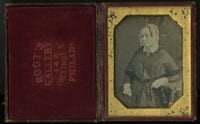
Marcus A. Root, photographer, Eliza Y. McAllister, quarter-plate daguerreotype, ca. 1850.

Marcus A. Root, photographer, Eliza Y. McAllister, quarter-plate daguerreotype, ca. 1850.

Eliza Young McAllister (1786-1853) is the mother of Philadelphia antiquarian John A. McAllister (1822-1896), who donated a collection of more than 50,000 graphics, manuscripts, and ephemera to the Library Company in the late 19th century.  A selection of this material will be on display in our spring 2011 exhibition, John McAllister’s Civil War: The Philadelphia Home Front.

$200


Love and Death in a Barn; or, the Sad, Sorrowful Life of Beautiful Kate Harrington … . (Philadelphia, 1876).

The Stranger’s Illustrated Pocket Guide to Philadelphia … . (Philadelphia, 1876).

Sweetness and Sorrow in Centennial Philadelphia 

Love and Death in a Barn; or, the Sad, Sorrowful Life of Beautiful Kate Harrington … (Philadelphia, 1876).

The Stranger’s Illustrated Pocket Guide to Philadelphia … (Philadelphia, 1876).

In 1876, America celebrated its 100th birthday and the biggest party was in Philadelphia, at the Centennial Exhibition. Many publications were produced as part of the Centennial to welcome visitors to the city and help them make their way through the exhibition and the surrounding metropolis. The heavily illustrated Stranger’s Guide highlighted the best of the city (i.e., the Library Company) and featured a healthy selection of advertisements for the finest wares to be had in Philadelphia, including Whitman’s confections. But not all was sweet in the city in 1876. Love and Death in a Barn tells the tragic tale of lovers from different castes who defied convention and the wishes of family, married, and then lived in such poverty that Kate at last died of starvation, after imparting a final kiss on her baby boy. Several full-page illustrations depict the heartbreaking scene, including one on the purple paper front wrapper, where the enclosed story is described as “a true incident of Centennial city life.” This volume also contains the moving story of Mary Morton, who died in agony after a visit to a “doctor friend” of her lover, while staying in the Philadelphia boarding house of Madam Learge, who, herself, later committed suicide.

Sponsored by Joseph Lippincott

   
The True Narrative of the Five Years’ Suffering & Perilous Adventures, by Miss Barber ... A Valuable Feature of This Work Is the Indian Receipts (Philadelphia: Barclay & Co., 1873?).

The True Narrative of the Five Years’ Suffering & Perilous Adventures, by Miss Barber ... A Valuable Feature of This Work Is the Indian Receipts (Philadelphia: Barclay & Co., 1873?).

Woman in peril! Stories about Indian captivities were page-turners for 18th- and 19th-century Americans. This fictional account of the experiences of “Mary Barber” suggests that she survived and returned “East” with valuable Indian remedies. For example, one learns that a tea made from equal parts of Wee-ne-oh (mandrake), See-tu-bar (spearmint), and Wanc-to-o (cream of tartar) would be effective in treating diseases of the liver, dyspepsia, obstructed menses, dropsy, venereal diseases, and other ailments. Note, too, the bilingual captions on this illustration. One suspects that Barclay & Co. also issued a German-language edition of this action-packed story with its appendix of home remedies.

$100

   
Henry Whipple, at His Book, Chart, and Stationary [sic] Store, No. 6 Franklin Place … Salem … Mass. Has Constantly for Sale a Large and Valuable Assortment of Books … . (Salem?, ca. 1810-1820).


Henry Whipple, at His Book, Chart, and Stationary [sic] Store, No. 6 Franklin Place … Salem … Mass. Has Constantly for Sale a Large and Valuable Assortment of Books … (Salem?, ca. 1810-1820).

Henry Whipple’s shop in Salem, Massachusetts, had something for everyone. Here one could find family bibles from 87-1/2 cents to 40 dollars, school books, and issues of the most popular periodicals. Standard bookstore fare found at Whipple’s included stationery, ink, blank books, blank forms, and paper hangings. The largest portion of text in Whipple’s ad, though, was dedicated to hawking the shop’s assortment of “valuable family medicines,” including Dr. Robertson’s Infallible Worm Destroying Lozenges, Godfrey’s Cordial, Circassian Eye Water, and the Balm of Iberia. The Library Company’s ardent interests in early American printing and publishing, patent medicine, and economic history are all referenced in this one small (21 cm.) broadside. 

$150


SSL Supported Transactions

Online payment Terms of Use